Cook in Bali
Cobek and ulekan: cooking with a Balinese stone mortar
Grind on the Petulu stone
IDR 350.000per guest, shared class
The flat stone mortar on every Balinese kitchen table: why cooks still grind by hand, how to use one without spraying chili, and what a blender misses.
By Chef Wayan Suryana, Warung Tumang BaliLast updated
The short answer
A cobek is a wide, shallow Indonesian stone mortar, and the ulekan is its horn-shaped pestle. Grind salt and hard spices first, then shallot, garlic, and chili, rolling and pressing rather than pounding. Crushing releases more aroma than a blender and keeps the paste thick. Guests grind base genep this way at the Petulu cooking class near Ubud.
What a cobek is
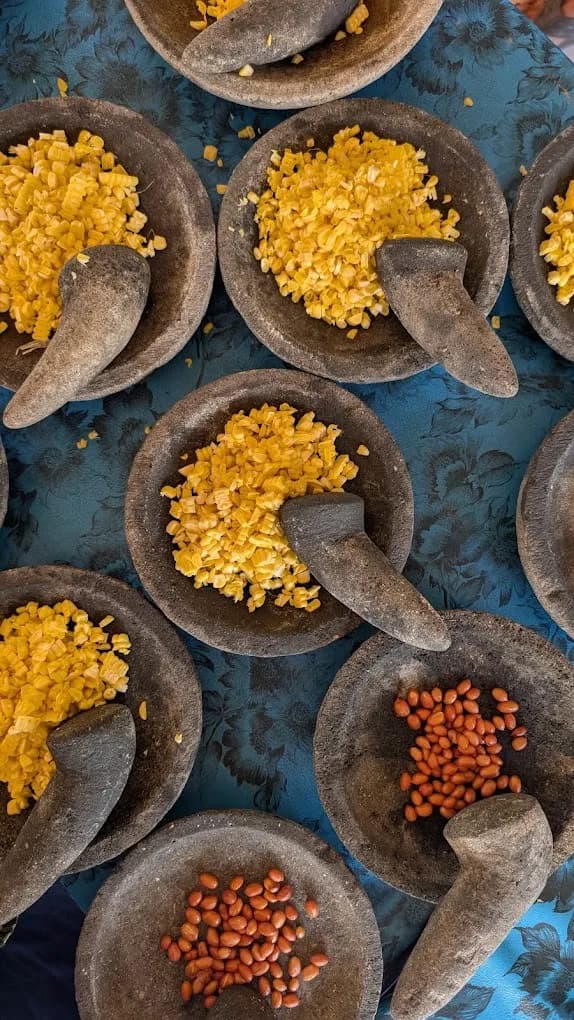
A cobek is the wide, shallow stone bowl; the ulekan is the pestle, shaped like a curved buffalo horn. Indonesian ones are usually cut from volcanic stone, heavy enough not to slide on the table. You hold the ulekan at an angle and grind against the flat floor of the bowl, rather than pounding down into a deep cup.
At the Petulu class table a row of them is set out before guests arrive, some already holding diced corn or peanuts, so each person grinds at their own stone.
How to grind without making a mess
Start with a pinch of salt and the hardest things: candlenut, coriander seed, white pepper. The salt gives the stone grip and draws water out of what comes next.
Roll and press; do not pound. Push the ulekan away from you and pull it back, leaning your weight on it. Pounding straight down sends chili out of the bowl and onto your shirt.
Add the wet things last: shallot, garlic, chili, and fresh roots. They break down fast once the dry base is fine. Stop when the texture suits the dish: fine for base genep, sandy for peanut sauce.
Why not a blender?
A blender slices; the stone crushes. Crushing breaks open the cells of shallot and roots and releases their oils, and the paste stays thick instead of being thinned with water to keep the blades turning. You also feel the texture as it changes.
Plenty of Indonesian home cooks use a blender for big batches, and it is fine at home. Add a spoon of oil rather than water, and fry the paste a few minutes longer to cook off the raw edge.
Taking one home
Household stalls in Balinese markets sell stone mortars in several sizes. They are heavy, so weigh your luggage allowance before you buy a big one. Season a new stone by grinding a handful of raw rice, then a few garlic cloves, to clear loose grit, and wash it with water only.
Learn the motion at the table
The roll-and-press is easier to copy than to read about. In the Warung Tumang Bali class you grind base genep first, before anything goes into the wok, then come back to the stone for the rest of the meal. By lunch the motion is in your wrist.
Questions before you book
- What is the difference between a cobek and an ulekan?
- The cobek is the shallow stone bowl; the ulekan is the curved pestle you grind with. Together they are the Indonesian mortar and pestle.
- Is a stone mortar better than a blender for spice paste?
- For flavor and texture, yes: the stone crushes rather than slices and needs no added water. For a big batch at home, a blender with a spoon of oil is fine.
- How do I season a new stone mortar?
- Grind a handful of raw rice, discard it, then grind a few garlic cloves. Repeat until no grit shows. Wash with water only, no soap.
More on cooking in Bali
- Balinese ingredients and what to use insteadBalinese ingredient substitutes: kencur, candlenut, salam leaf, palm sugar, shrimp paste, and fresh turmeric. What each one does and the closest swap at home.
- Balinese dishes worth learning by handWhich Balinese dishes to learn in a Bali cooking class: base genep, sate lilit, sambal matah, pepes, and dadar gulung by hand; betutu and tipat at home.
The recipes, written down
- Base genepHow to make base genep (bumbu Bali): pound shallot, garlic, roots, and candlenut, then fry 8–10 minutes until the raw smell is gone. From a Petulu kitchen.
- Peanut sauce for sateBalinese peanut sauce (bumbu kacang): fry peanuts, grind them with chili, garlic, and shallot, then simmer with palm sugar and sweet soy. No peanut butter.
- Sate lilitHow to make sate lilit: mix fish or chicken with fried base genep and coconut, wrap it around lemongrass, and grill. Twelve skewers from a Petulu kitchen.
Plan the day around it
Where the kitchen is
Chef Wayan Suryana at Warung Tumang Bali, Banjar Laplapan, Petulu, Ubud, Gianyar, Bali 80571. The kitchen is about 10 minutes from central Ubud, depending on traffic. Pin -8.4945671, 115.2812928.